
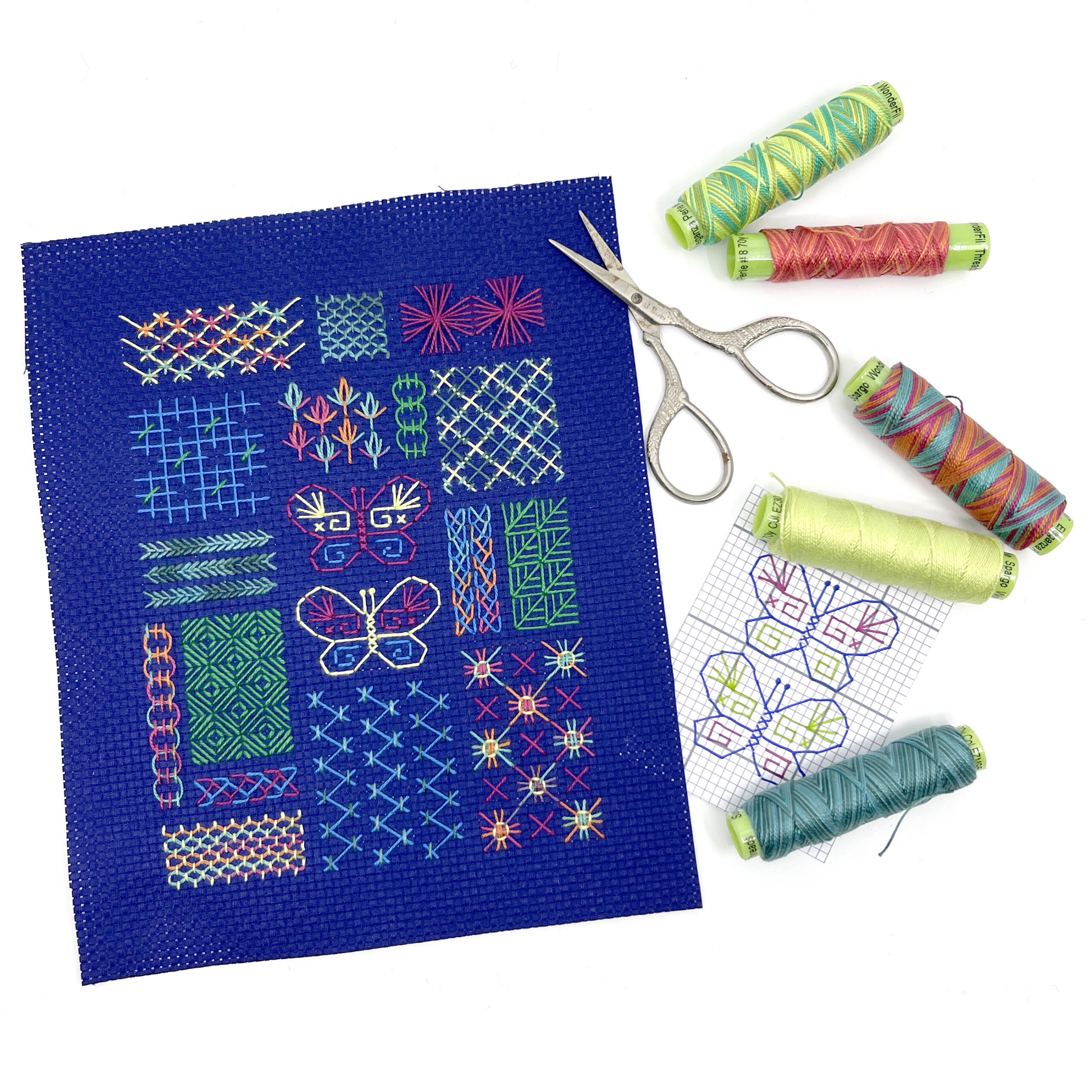
I just wrapped up teaching the Zoom version of my Modern Blackwork Embroidery Sampler class. We had such fun stitching it and for my group who have been meeting together weekly for several years now, this project had a unique challenge: counting.
So a little here’s a little history lesson. Blackwork has been around for a long time. The version you see if you Google the words “blackwork embroidery” was popular in the English Renaissance, although similar kinds of counted-thread embroidery were being done in other parts of the world much earlier. Traditionally, it was black silk thread on off-white linen, and it was often used on clothing, especially places like collars and cuffs. The reason it was specific to those parts of garments is because the traditional stitch, called the Holbein or double running stitch, is reversible. Since you can often see both sides of the fabric on collars and cuffs, that meant your stitching looked good no matter which side you were seeing.
A lot of the early designs were geometric and floral, which makes sense when you’re stitching on an even-weave fabric that gives you a built-in grid. It’s a pretty good setup for crisp geometrics and repeating patterns. Floral patterns were outlined in a back stitch and filled with smaller patterns. Modern interpretations vary both the colors and the stitches a little bit. There’s a really charming traditional-style pattern from the Embroiderers Guild of America on this page that features honeycomb and bees; you can download it for free if you sign up for their newsletter.
 For my version, I wanted to make it a little more interesting to stitch and to give my embroidery enthusiasts a new challenge. We stitched this sample on Aida cloth. It’s usually used for cross stitch, but it’s a really easy-to-find even weave fabric, the perfect thing for geometric patterns. I chose navy blue to give this a modern twist using the same idea of light and dark, but making it have a dark background and bright colored stitches.
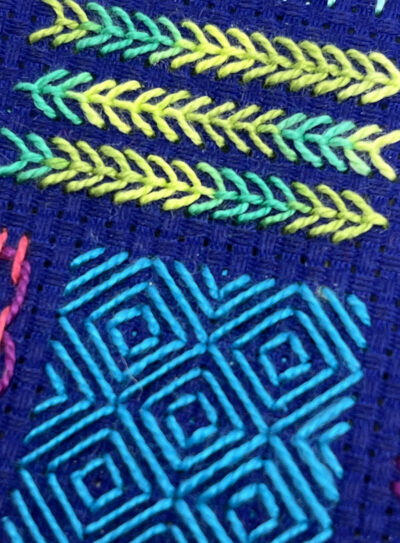
Several of the sections use traditional blackwork stitch forms, but I added others to give us a chance to take what you might think of as standard embroidery stitches, like herringbone or fly stitch, and work them on a grid instead of freehand. That fly stitch section in the aqua and green (to the left) was particularly satisfying to stitch using the grid to make the stitches so precise.
One thing I kept more traditionally blackwork was the style of the thread. Most embroidery classes I see use 6-stranded embroidery floss because it’s really easy to find in nearly any craft store. But I didn’t think that stranded style really looked like blackwork when stitched. So I made the sampler in size 8 perle cotton. Perle cotton is another kind of embroidery thread, but it’s meant to be used as one single thread. You see it a lot at quilt shops because it’s nice for decorative hand quilting. It’s honestly my favorite kind of thread to stitch with. The smooth perle cotton looks a lot more like the kinds of handspun silk threads that would have been used in blackwork in the Renaissance.
I also chose three variegated colors of threads to add some interest to the stitches. I love how the color gently changes from acid green to aqua as you move down the row of fly stitches. (This is Wonderfil Eleganza perle cotton color EZM14 Lettuce Wrap.) And here’s a tutorial for the fly stitch if you want to try a little on your own.
Why did I do all of these variations? Because spending 12 lessons doing one specific blackwork stitch structure turns into a class that’s just about counting. And that sounded really boring for everyone. So I looked for different stitch structures that kept the flavor of blackwork embroidery but gave some different architecture to work with. That’s really what I wanted from this sampler: not to make a perfect reproduction of historical blackwork, but to understand what makes the technique work well enough that we could start playing with it.
The whole class agreed that the plaited feather stitch was the biggest challenge. Which is probably a good thing. I don’t think a class should be completely comfortable from beginning to end. There should be at least one point where you have to stop, look at what you’re doing, and think, “Wait. How does this work?”
If you are intrigued and want to try some of your own, you can find the Modern Blackwork Embroidery Sampler class on my website or at Skillshare. Those are on-demand so you can start right now and come back whenever you have time to stitch. The best part of this class project, I think, is that you don’t have to make a whole sampler. Each stitch is its own block and its own lesson, so you can try the ones that intrigue you or stitch the whole thing and try them all.