
AI has come up in a lot of conversations in the last few weeks. I put a tiny sign on my vendor table at the show that said “No AI” and I am almost certain it is the most read and most reacted-to sign I have ever posted. I got a lot of high fives. A few evenings ago, I sat on a panel titled “Creativity in the Age of AI” and described AI as “my arch nemesis”. When I applied to be a “Trusted Vendor” on Fybe.art, one of the criteria they asked for was a public statement about AI. I have had a “No AI” line on my site and my shops for quite a while but I thought it was maybe worth talking about a little more.
The arch nemesis
So why do I call it my arch nemesis? When I said that I was thinking about one specific story. Almost a year ago, I had been having issues with my website hosting. I had switched to a new web host several years ago and it was fine, but the cost kept going up. I had constant trouble with the site being flagged for being over bandwidth and visitor limits. This sounds like a great problem to have: my site was crazy popular. But that was so completely untrue. I tried deleting years worth of content off of the site to bring the numbers down even though I really didn’t want to do that. I talked to tech support trying to find out what was happening, sure it was a mistake.
I remember telling the tech support person on the phone that if I really had 40,000 visitors a month to my website that my business would be a hell of a lot more successful than it was. They didn’t think that was amusing. They told me that I had to “upgrade” my hosting in the next 30 days to pay for the extra traffic and it would be 4 times what I was already paying.
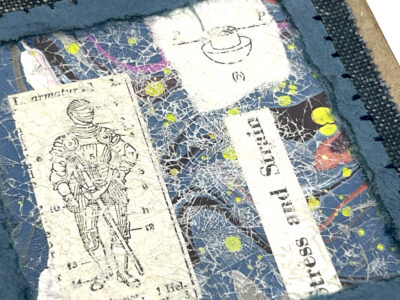 I spent weeks trying to figure out where the traffic was coming from, talking to tech friends and tech support, installing analytics and pouring over every report I could find and finally confirmed that it was AI bots scraping everything off of my site to feed it into an AI model. Over and over. None of that traffic was real visitors, just bots stealing my words, tutorials, photos and everything. One tech support person helped me install a simple blocker that cut down some of the junk traffic, but the bots found ways to work around it.
The web host had nothing in place for users to be able to block this traffic and absolutely did not care. They were adamant that the only thing that I could do was to upgrade and pay for the AI bots to steal my work. I finally had to shut down completely and move all of my hosting somewhere else. Fortunately I found a place that seems to have way better safeguards in place to filter out the garbage. I got some help to block the most common AI bots.
I have heard people say that getting ChatGPT to draw a picture for you isn’t hurting anyone. But it absolutely is hurting me. Because it costs me real money when the data mining bots constantly target my website. And I know that my art is now feeding the picture drawing AI bot and there is nothing at all I can do about it. It feels just like a stranger walked into my studio and grabbed something off of my table, wrote their name on it, and stuck it up on their wall.
AI and designing fabric
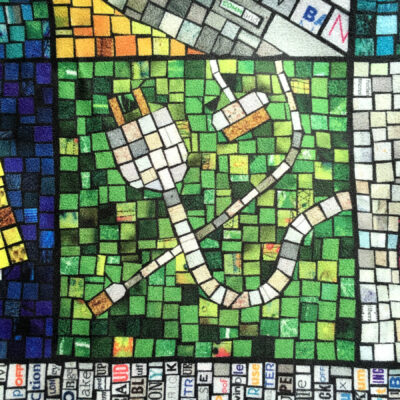
I told a story at the panel discussion about showing my work at a big prestigious show about 15 years ago, way before AI was a word that anyone but computer science geeks talked about. I was designing a lot of fabric then and had a whole booth full of pieces made with my fabric. A guy and his daughter were there and asked me about the patterns: “you really make all of these yourself?” So I was telling them all about my process. I make paper illustrations and use handmade art papers and recycled papers. Then I scan it and take it into Photoshop to make a repeating pattern….” And the guy interrupted me and said “That’s CHEATING. Everyone knows that Photoshop does all the work. That’s not real art.”
I was stunned into silence. And stammered something trying not to be rude. And said something about how it’s funny that no one ever says anything about the computer that’s in my sewing machine, but somehow, using a different computerized tool is not ok. I made a whole new art piece about this conversation later.
After I talked about AI in my most recent newsletter somebody asked “What about Photoshop?” And I am absolutely not going to stop using Photoshop. I use it nearly every day and I have for 20 years. I am good at the things I use it for; I only use 20% of what Photoshop is capable of. Does it have AI features? Absolutely it does. Many of them I can toggle and turn off, which I do. Do I wish I had more control over those choices? Yes, but I don’t. I can’t read the code and decide what is using “good” AI and what is not.
I choose not to use Photoshop’s AI tools because I like making art. I don’t want any tool to do it for me. I make art to share stories, make connections, discuss ideas. No one can do those things for me. Writing some prompts and taking whatever comes out isn’t making anything; it’s letting an algorithm curate someone else’s ideas.
AI promotes mediocrity.
AI can be used to analyze mammograms and look for abnormalities that are too small to identify clearly. It can look at millions of results and find things that are common to those images, correlate, and give a result that is incredibly valuable. Do I want AI reviewing my mammogram? Abso-freaking-lutely. I also want my doctor to look at it and make an informed recommendation, but I want that data to be something she can use to help her. That’s a case where AI giving you the common answer is awesome.
AI generated algorithms for artists are the exact opposite. An AI search for a class about fabric design, for example, is going to give you the most common result. So everything becomes pay-to-play. I have to promote the &(@!$# out of everything I do to tell the AI, hey this is the answer to that search. And I have to do that more than anyone else is doing that, but I can’t do it in a way that looks like I am trying to manipulate the algorithm. And you know what? I can’t do it.
 Etsy search engine results are the same thing. When you search for a cross stitch pattern for example, you get the most liked, clicked, favorited, advertised, purchased listings first. Every time one of those things happens, the algorithm notices and thinks this must be the best one because it’s getting attention. All of those things the algorithm looks at are nothing that a seller controls. It tends to snowball and this is even a pattern I can see in my tiny Etsy shop: someone purchases an item, the algorithm says oooh this is something customers want, so it bumps it up the search results, so someone else purchases it and so on. I nearly always see items in waves. Right now the mini loom kits I make are my most popular item. I didn’t do anything new or different. I’ve had this same item for 10 years. But last month I had 3x the number of sales. I might have none this month if the little algorithm boost bubble pops.
I’ve had comments about how I must use AI for my photos because they are “too good”. This is another example of mediocrity. I don’t use AI for my photos; I’m just good at taking photos of my work. Why? Because I have spent hours learning how to be good at it. It’s something I studied at and worked hard to learn. I couldn’t afford to get my work photographed and so the best solution I had was to learn how to do it. I have heard of a number of artists who are deliberately leaving flaws in their photos – dog hairs, shadows, not quite perfect styling – so that they can “prove” that it’s not AI generated. Think about that. Knowing how to make awesome photos and deliberately not using those skills so that it can look more human made.
What is AI really helpful for?
I can’t avoid AI use completely. It’s used absolutely everywhere now and unlike foods, it’s not required to have ingredients labels where I can check for potato starch.
Yes, there are a couple of things I think are good. I like spell and grammar check. That’s a kind of AI. As an artist, one of the most infuriating tasks I have to do on a regular basis is to take something I’ve written and cut it down to 500 characters or 300 words to fit into the answer box on a grant application, exhibition call for entry, workshop description etc. Every single one has a different requirement. AI tools are brilliant at that.
I don’t need the “help” to write the thing. AI can’t write about my art because it’s NEW. Everything AI writes for you is copied from something that already exists. So it’s no help writing if there’s nothing to copy. It just generates garbage spitting back the most common thing it finds when it looks for something. Nobody needs that.
What does “No AI” mean when I say it on my site and those signs?
I don’t use AI generated content. It is not a part of how I make things and it’s not a part of my artistic process. I don’t like that those tools are hurting other artists, authors, and creators of all flavors. I want my work to be my work and not copied from something else. I say “No AI” because I want to be transparent about that. I want you to know that when you look at my work or make a decision to purchase something I’ve made.
I don’t want to say no one can use AI. I am not an expert on all of the ethical and environmental consequences and I am absolutely not qualified to tell anyone else what they should or shouldn’t be doing with AI. I hope I can continue to learn more and to make good choices for myself. I hope that there are experts that will help write some regulations and protections. I want to foster discussion about it by participating in panels and writing posts like this.
Content-scraping bots, generative AI, search algorithms, and the endless cycle of trying to get seen by the algorithm are all parts of the same problem. Creative content is being turned into data and then fed back into the algorithm that decides what other people see. I’m trying to do my part to break that cycle.
Beyond the apparent need to say “No AI” when it isn’t being used to create art, there’s a real need for regulation when it IS being used in our daily lives. After a recent plumbing emergency I had to make a spate of calls to plumbers. 3/4 of the “people” I spoke to were clearly AI generated voices introduced by their “names” as the “service representative” who would be helping me. These included fake sounds of a call room in the background and careful, evasive responses when I asked if they were AI and if there was a real human I could talk to. We hired the guy who actually spoke to us.
If AI is being used, it should come with an up-front disclaimer.
If we don’t want to use it in whatever application we’re using, from email to shopping or n line, we should be able to electively turn it off for whatever concerns we have with using it, from privacy, to protection of intellectual property, to conservation.
AI has its place and applications, but it shouldn’t be everywhere without regulation or costs to those who deploy or use it.